Tuesday, March 23, 2010

Nero 7 Ultra Edition Plug In

Coursework : Analysis of sources of information on research


Introduction:
proposed course work, is to put into practice the skills of identifying, describing, cataloging, classification and management of information sources research centers. Bearing in mind these are the main generators of scientific production, the documentation can not be excluded from treatment. While it is true that there are major research centers directory, it is also true that there are significant gaps in the qualitative and extensive description of the activities, functions and sources of each one of them. Paradoxically, the exorbitant growth of scientific literature, far from being controlled, is important channels from legacy sources of research from document types and media and communication expertise and constantly evolving.

Bases:
  1. job preparing the course, students will have a user account CUMULUS experimental system, which normally receive in the mail stating.

  2. Work will be performed CUMULUS entirely by the system, available at: http://www.mblazquez.es/testbench/cumulus/

  3. Each student will be assigned 4 research centers, which will be analyzed in depth, including sources derived information, whether arising third research centers, libraries, journals, databases, directories, indexes multimedia materials, research series, etc.
Part 1: Analysis main
  • Title. Title and Subtitle: Name or original and translation thereof. Original language - English - English.

  • Web Site URL Syndication: URL official website of the resource and its content syndication channel if available.

  • Typing of supply: typological classification of the resource in response to the web typology, typology by origin, type depending on the level and type depending on the content

  • Scientific Areas and specializations: determine which areas research or scientific branches that specializes Research Center. UNESCO classification used to establish the classification or category / s appropriate.

  • Which centers, laboratories or research departments owns CI: Lists research centers attached if any, and briefly discusses his research commitment.

  • Catalogs automated for consultation of bibliographical-documentary: Determines whether there Catalogues automated to facilitate the consultation of bibliographical-documentary as an OPAC. To find them, determines whether or Library Documentation Centre to act as liaison for informational center's research areas.

  • Periodicals - magazines, journals published What research center selected. List them and include your name, department responsible, subject and if they were electronic link.

  • Publications Database: Which databases offered by the research center, list them, reference them and include name, department responsible, subject and its direct if they were accessible.

  • Publications monographs, manuals and reports: In many research centers published reports, yearbooks, bulletins, monographs and textbooks with references to research, scientific results or summaries of articles in scientific journals. List some examples and includes bibliographical reference, if provided. Determine if it is possible to access network. If so include link to the document.

  • dissemination systems and communication of scientific knowledge: What mechanisms have Research Center to disseminate and spread knowledge of its own website. Syndication feeds, user profiles and researcher, specialized scientific information portals, etc.. In if any, enumer alos and comment briefly including your direct link URL if available.
Part 2: Treatment of the sources of information derived
Having described the research, there will be an analysis of the sources that these are derived by keeping the following schedule:

The outline proposes an analysis of institutional sources, in this case "research", but these are derived from research groups, laboratories, projects, etc, to find documentary sources for databases, directories, magazines, scientific articles, etc..

The objective of this second part of course work, is to describe the documentary sources dependent on each documentation center. according to the following considerations:
  • Each student will describe 3 sources of institutional information derived from each research center
  • Each student will describe 5 sources of documentary information derived from each research center. In total, 20 fonts that can be databases, magazines, directories, etc. (Provided it is considered documentary sources).
  • All sources information will be linked together through the configuration options offered by the system relations CUMULUS.
  • All sources described are ranked with integrated thesaurus tool CUMULUS.

Thursday, March 11, 2010

Are Burping And Farting A Sign Of Stomach Flu

09 .- The Centers for Documentary Production and Research in Science and Technology: Introduction

One of the main sources of scientific output from the scientific, research and documentary are the major research centers and consortia that develop under the auspices public and private funding for states and companies iniviativas or private. Thus becoming a center of resources and administration for the concentration specialists, scientists and researchers who carry out collaborative work, for the achievement and development of new developments and knowledge for dissemination and practical application. Given its dimensions allow means of action lines and policies and structuring scientific Invesiones a country dedicated to research and development. While not all the scientific production is reduced to such institutions, it does much of its work has an impact and effect on the overall development of scientific research in basic sciences and experimental.

As cited, the great centers research are a conglomeration of specialists trying to cover the various branches of knowledge or science that may be established subject categories. Put another way, how to organize research, depends on the departments in which they are formed, so that these structures are defined and demarcated in organization of such institutions. The existence of the departments has a direct relation to three key factors: 1) On one hand the interest in establishing research policies in a country or a private institution for scientific research in a very particular area, 2) second capacity of profitability economic and usefulness of the research carried out in this area, 3) finally, the availability of really qualified researchers to conduct such investigations, aims and objectives.

Results in many cases complicated the maintenance of these facilities investigation, taking into account and the amount of multidisciplinary science and knowledge areas to be covered to ensure smooth progress in all of them. Therefore, in many cases, research is divided and reduced to certain scientific disciplines in which the center is in a leading research position or theoretical-practical domain and technical or technological. Given this situation, careful planning is made that seeks a balance between profitability-Objectives-Outcomes-Research so that the investment was originally reverse multiplied in practical applications to better use and impact. An exception to this rule is the famous MIT (Massachusetts Institute of Technology), covering all areas of scientific knowledge and promote interdisciplinary collaboration of the best researchers worldwide to obtain the best scientific knowledge pointer.

However research centers main work, achieve a harmonious growth of knowledge through international scientific cooperation in diverse areas, by pooling human and technical resources to create real scientific focus groups that result in super-specialized research institutions. An example of this is the CERN (CERN - European Organization for Nuclear Research), in which nuclear physicists are the best place for the study of subatomic particles through instruments of high value and technological level of development and global cooperation and international as it turns out the familiar accelerator and Hadron Collider or LHC .

For major research centers and institutions articulate their work, studies and research in an efficient and agile, they require ongoing investment in documentation so that they can develop information and documentation departments, whether arising documentation centers , libraries or archives to facilitate the work of documentation and scientific researchers. The use of scientific information is only matched by its production. For this reason there are two essential key recovery information for any possible access point that identifies the document for users to quickly provision and on the other hand, the essential key to register and have all the news published by other research teams around the world working in parallel in the same areas of research to avoid duplication of research, duplication and costs of time and money involved.

This means that there is a great activity librarianship-documentary that is reflected in real catalogs and inventories of restricted-access public-private-quiet according to the policies of disseminating information from research centers. The documentation of the secondary type is usually transmitted by the so-called Current Awareness Services or service is the same for continuous updating of all the new literature-webibliográficas documentaries that take place in real time. This means that documentation centers and academic libraries have a mission to contribute selectively to each specialist the most current information from a variety of catalogs, databases, indexes and tertiary documentation available. This work was made possible by the provision of search and alert services that allow retrieval of information, directly and indirectly through such sources of information, ultimately obtaining information refined, and relevant reference to the location, quantity and quality of the available scientific literature, demanded by the researcher.

Consequently Research Center is considered a major center for the production of documentation in terms of services, information sources and research studies and publications generated in the discharge of their duties.

parameters for the analysis of research centers

Research Areas: should determine which areas of each site investigation work by the UNESCO classification system known, particularly in the methodology for the practical study of this subject. This is a standardized way of determining each specialty, allowing to distinguish the extent, degree of specialization and dimensions involved in their work compared to other centers. In the end also enable us to ascertain in advance that in such areas can be resources and specialized information sources, both from the standpoint of formal and informal, as well as type primary, secondary or tertiary, to a greater or lesser extent will be accessible network.

Document Services: are services, activities and processes common and specific to the Documentary Channel documentation centers (Cataloging, Classification, Indexing, Abstract, emptying their magazines ...), but to highlight the following for their importance to the channel information Scientific:
  • Consultation Service, Search and Information Retrieval for the researcher: Undoubtedly scientific information centers have specialized teams of filmmakers in the query and retrieval of information through catalogs, databases and codes themselves and others who have been employed to increase thematic coverage, documentary and geographical scientific publications. Being a super-specialized services to analyze the user's query and researcher is desfragentada minimal meaningful units in obtaining an expansion of the significance of the request for information. In this way, include such factors as the extent of the information, its bibliographic data, context, theme-qualifying coverage, temporal, chronological, bibliographical and descriptive to be refined and filtered on several searches through catalogs, databases and recovery systems and other specialized secondary literature and tertiary.


    Outline specialized search process for the researcher.
  • DSI S ervice warning bibliographical-documentary research: services for selective dissemination of information provide automatic alerts of new books and documentaries related to the field of scientific study by researcher the definition of thematic interest profiles, obtained from consultations and searches carried out by each user. The warning process begins with the updating of catalogs and codes of journal articles, databases, bibliographies with a frequency almost instantly reduced even insert new results from research and scientific activity. These publications are collected according to agreed criteria and theme-qualifying standard for the documentation center for dissemination among the various departments that make up the research institution. For this is done a user study, based on preference profiles, and publications that represent the lines of basic research, which can be defined and represented by third publications. Thus, retrieval and dissemination of new documentaries, is made by grouping or clustering, given the characteristics common to all publications that keep the same route or screening criteria.
  • Publishing and Databases: Essential Job documentation centers active in research, compiling all the bibliographic and documentary production theory and practice of researchers and scientists. This requires the proper classification and standardization of publications so that their identifying features, descriptive, corpus or original content, results, -critical or critical apparatus are properly represented, argued and collected for documentation and dissemination through publications channels and secondary or tertiary to facilitate access. This section is common to find the following publications derived from scientific knowledge:
    • Periodicals: Mainly scientific journals in the areas of leading research center. An important criterion for assessment is their presence in the impact factors, citations and international repertoires. For example, Science Citation Index , Latindex , ISI Web of Knowledge, Journal Citation Reports , etc.

    • Repertoire of Periodicals: In addition to offering its own scientific journals , research centers often have directories, catalogs or indexes major journals in each area of \u200b\u200bknowledge consistent with their specialization research or study. The same way. Please note that not only has the link, link or bibliographic reference of the publications if not their impact factor, categorization and classification, licensing consultation and online access, literature alert service independent of specialized articles for each issue, so as to facilitate their treatment in literature management systems.
    • Monographs and Manuals: correspond to studies of longer range as a result of theses, research projects and project execution planning for results, or the development of working guidelines, methodology, technical and testing of academic and scientific value-informative. Are series of monographs common thread which is a subject area in which the center is an expert researcher and pointer. For example, aquaculture monographic collections of ancient CINDOC.
    • Databases: Depending on the number of publications, monographs, journals, newsletters, pre-prints and other gray literature, the documentation center under the research institute can create databases of local, global or international state to offer a wider dissemination to provide the free presentation and dissemination of science, as well as cooperation and development Sharing research with other experts in the world. In this way, it assists in the development of original content, avoiding the risk of duplication of future research. It also involves a method for unification of all types of documents produced by research, for its recovery block. In fact it is a common practice of cataloging and classification jointly by all the documentary material for later retrieval in a sorted and filtered according to the documentary style, his themes, chronology and even according to the research group at source corresponding information demanded.
    • Repertoire Database: While a database or a global catalog of the scientific production of a research center, facilitating the dissemination of knowledge itself, it is necessary to generate global codes, complete and accurate in all databases possible data related to research policies and guidelines of the institution and its researchers and scientists. In fact, the systematic investigation of these sources, facilitate the direct-indirect retrieval of documentation and information requested by the user, expanding the queries that could initially be restricted only to a more localized. The result is a more complete, real or reliable, allows for all existing references in the world about a subject or object of study. Therefore, the researcher can build on a research basis for more reliable by reducing the risk of inventing what may have already been invented. For example reference is a must for any researcher searching the bibliographic databases CSIC like database summary ICYT science and technology.
  • Request Service Documentary: Essential for replenishment and distribution scientific literature in the workplace as scientific and research department to which it belongs. In many cases this service has its digital-electronic extension that enables web access information from any point or location. Put another way, the natural history documentary service request is the scientific digital library in some schools like MIT Libraries being widely integrated into the service activity and dissemination of research service.
  • Documentary Service Platform for Research: In many cases the information and documentation center prepared in cooperation with scientific research departments of each institution, authentic intranet services for the particular document management of research carried out in the various working groups. This adaptation of virtual workspaces are called documentaries platforms for research, whose most visible result known as the Scientific Information Portals. This means that a research center can consist of departments whose research groups generate specialized information portals, interdependent and subordinates under the global scientific output of the institution. A case in point is the distribution of research areas that underlie MIT's Research Laboratories in preparing joint research projects, grouped by working groups and research portals to virtual shaping interdisciplinary work that effected. For example, research portals dedicated to the development of industrial technology policy programs at MIT .
  • Referral Service for Web resources. Directories. Scientific Information Portals: The information gathered through databases, directories of journals, collections of monographs, citation indexes, etc, is not always sufficient to provide a complete picture of all possible sources of information. In fact, there are codes of web resources and specialized directories, portals for scientific information (cited above), portfolios, blogs, formal and informal communities of researchers, associations or institutions and associates or related to the study center, etc.

South Park For Ipod Streaming

Media 08 .- 07 .- Typology scientific

[in development]

Where To Buy Toter Trash Cans

Scientific Production Documentary

As part of the process of transmission and production of scientific knowledge, one of the purposes and objectives of any research is the dissemination of findings to their best advantage and use. The result of this intellectual process generates a rich variety of documents is vital to differentiate to establish a clear categorization and classification of resources and sources of information.

Primary Documents: are primary documents which by its original content, raise the status of knowledge of a particular science, contributing to this review, testing and demonstration so that their findings impact and impact on further research to get the ultimate objective truth and objectivity as it is confirmed as an object of study needed to understand the reality and the best use their applications.
  • Theses and Dissertations:


    • Doctoral Thesis Examples of Science and Technology: CHICO

      GONZÁLEZ, B.; MORCILLO LINARES, M. SORIA OTERO, E. Corrosion coated steel overlap joints. Madrid: Universidad Complutense de Madrid, Publishing Service, 2004 Available at: http://www.ucm.es/BUCM/tesis/qui/ucm-t25254.pdf
  • Patent and technical and industrial applications:
  • Conference Proceedings, Reprints, Pre-Prints:
  • Electronic Publishing in an article, essay, paper, manual or scientific-technical guide:
  • Tools, Instruments, Software, Source Code and Object: Documents
Secondary: side documents in scientific knowledge are part of products generated by documentary filmmakers and the managers of scientific information in particular. Document types are responsible for referencing and linking with new access points organized thematic, chronological and Onomastics to facilitate information retrieval and access to original documentation. Secondary documents on science and technology as the primary consists of a number of features of form and content regarding the presentation, description and organization of information in any case models the final result of the document.
  • encyclopaedic works and dictionaries:
  • Guides and Documentaries Specialty Catalogs: For Walford's Guide
  • example
Tertiary Documents: These documents are tertiary specialized in those types of documents systematically present secondary document types. This phenomenon occurs in the areas of fastest growing knowledge of content and obsolescence of information.
  • Records of Indexes, Databases Catalogs and Periodicals:
  • Reviews or Reviews:

Customize Soccer Mercurial Cleats

06 .- Users scientific information

[in development]

Tuesday, March 9, 2010

Best Bra Small Breasts

05 .- Upon obtaining knowledge Scientific

scientific knowledge as explained has characteristics that make it special and different to any other because his approach to this objective, tested, proven, repeatable under conditions previously defined and studied systematically in their definition, thoughtful and reasoned, delimiting and defining the object of study, fully aware as to their objectives and methods used to obtain original investigations, hypotheses, findings, conclusions and their critical. Get

scientific knowledge by the principle of induction: Inductivism
Inductivism arrive at scientific knowledge poses a universal law or comply with the following statements:
  • The number of observation statements that constityen the basis of a large or widespread sufficiently representative. Put another way, that the appropriate scenarios and representative samples of the study object being studied.
  • The observations made on this subject matter and especially with the sample chosen to be replicated. That is, the repeatability of the phenomenon under various conditions, detection and definition.
  • That the findings, conclusions and statements derived from observation of the phenomenon under study does not conflict with the law that was intended to prove.
Inductivism is based on 1) the observation of the phenomenon or object of study raised . 2) Argumentation and description of the object of study from observation. 3) Derivation and drawing of conclusions or statements from the statements and observations by reasoning, logical thinking, experience and empirical .

[in development] All

Thursday, March 4, 2010

How To Make My Own Concrete Tub

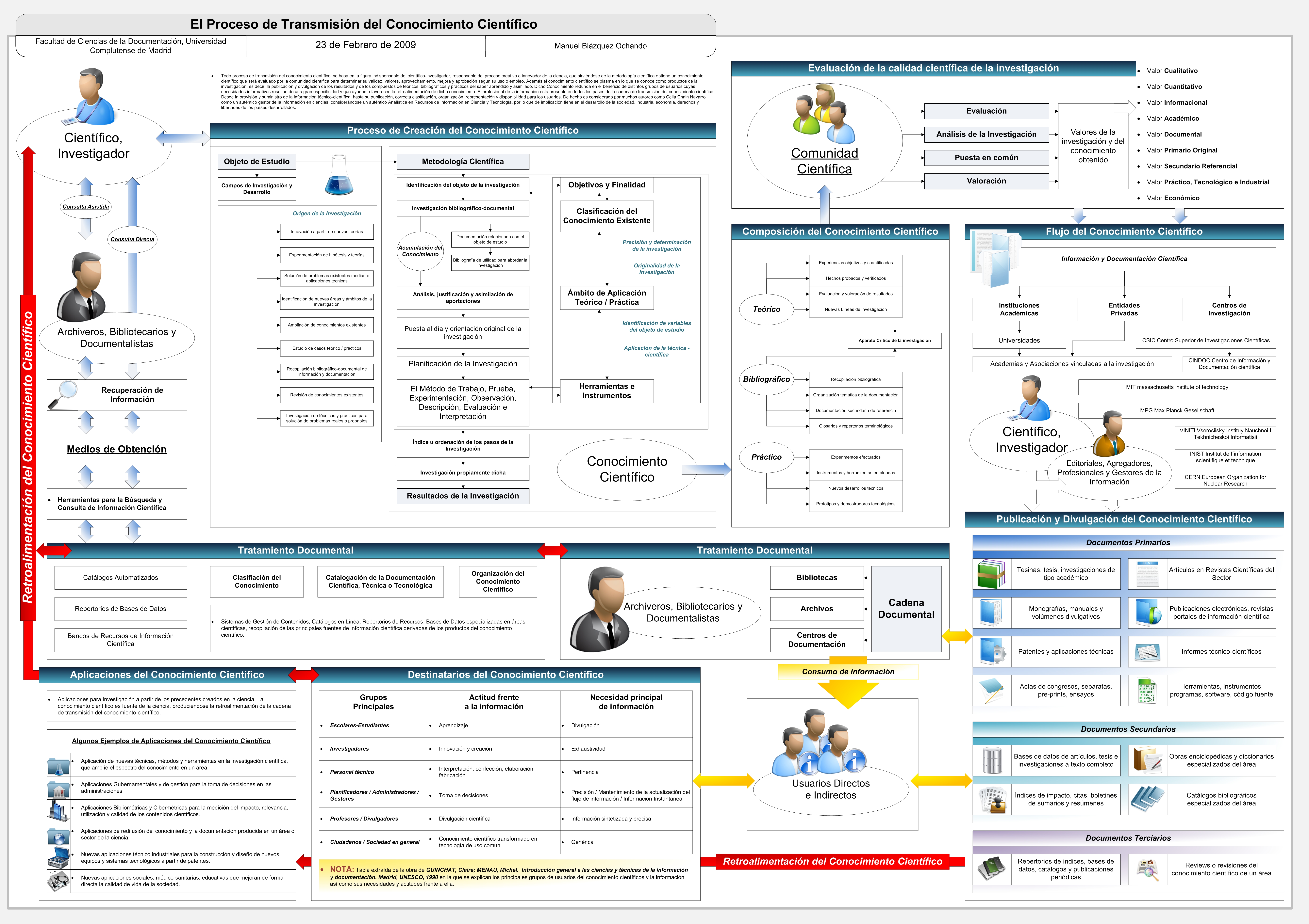
04 .- The Knowledge Transfer Process

process of transmission of scientific knowledge is based on the indispensable figure of the scientist-researcher, head of the creative process and innovative science, using scientific methodology to obtain scientific knowledge will be assessed by the scientific community to determine its validity, values, development, improvement and adoption according to their use or employment. Besides scientific knowledge is embodied in what is known as research outputs, ie, publication and dissemination of results and the compounds of theoretical and practical knowledge bibliographic learned and assimilated. This knowledge is in the benefit different groups of users whose information needs are of a high specificity and that help and encourage feedback from that knowledge. The information professional is present in every step of the chain of transmission of scientific knowledge. Since the provision and delivery of technical and scientific information until publication, correct classification, organization, representation and availability for users. In fact it is considered by many authors as Celia Navarro Chain as a real manager of information science, which was a Analist in Science Information Resources and Technology, that involvement has on the development of society, industry, economy, rights and freedoms of infonómicamente rich countries.

Tuesday, March 2, 2010

Valerian Root Tea Vs Chamomile

Scientific Practice 1: UNESCO Classification System

UNESCO classification is a valuable resource for the classification of information sources in science and technology because of its standardization and international. Locate the classification of UNESCO on the network using various sources of information, according to the following sections:
  1. For each consultation, note the following:


    • browser used.
    • text string used for the query. Total
    • results. Quote
    • full reference to source or resource selected as appropriate to contain the classification of UNESCO.


      • URL or website link or reference.
      • Author / Statement of responsibility.
      • Language / Action Place or Location
      • reference position in the consultations.

  2. Briefly describe the context of these sources of information and tries to determine if formal, informal, primary or secondary.


    • The context refers to the subject area in which information has been found. Depending on the origin of the source has been applied in a specific area of \u200b\u200bexpertise. Determine.
    • Regarding the first approach to the resource, whether it is a source of information of a primary or secondary according to their origin or as the domain where you are if institutional official, personal, academic , etc.

  3. Which areas of the UNESCO classification would be related to Science and Technology. Use the following appeal to base your analysis:


  4. Can scientific knowledge in the classification correctly classified UNESCO? What would you propose other classifications? Locate

  5. page BUCM resources (Complutense University Library) and determines whether the classification used by UNESCO for classification of resources.


    • Otherwise What classification method used?
    • What kinds of resources and information contain these pages? Would
    • as sources?
____________________________

practice results will be forwarded delivery paragraph practices UCM virtual campus for correction and evaluation.

Patron Saint Of Urine Infections

03 .- The standings in Science and Technology


One of the main problems facing the documentary is the correct classification specialized scientific knowledge in basic sciences, experimental and applied and industrial extensions, trade and technology. During the study of science documents have been used very different systems that largely cater to the needs of different materials qualifying under study. Thus such systems can be more or less effective in distinguishing the various branches of science and technology, depending on a number of factors such as:
  • factors Practicality and Usability: A classification system must be science easy to handle and apply, so that the allocation and refinement of scientific concepts is reflected in well-defined areas that channel the main branches of scientific knowledge by distinguishing between the great families of science to their place of study or discrimination so uniquely differentiates from the rest. A classification is practical when the forwards and identifies effectively without a doubt the scientific expertise through its descriptive features, indexes, glossaries, key terms and methods used during the argument from the scientific test. Referring to the handling, is accurate enough classification system Lightweight, synthetic and condensate to be easily travel to exhaust all possibilities quickly classification scientific issue to be addressed. This form must be a balance between thoroughness, accuracy and usability of the concepts and names of the branches of scientific knowledge that serve as qualifying mechanism. Based on practicality and usability factors simultaneously, constant numerical methods of organization of science for which correlative systems, decimal and numeric classifications must respond to very diverse, interrelated and hierarchical yet as it grows and extensible interrelated disciplines scientific. In other words the gradient that occurs as a result of the interplay of science with other sciences, resulting in mixed real sciences, heirs to two branches that had initially study and interpretation channels separate or different.
  • Factor Accuracy and Completeness: Any general or specialized classification in science and technology serves factors precisely because they must represent with fidelity and completeness of scientific knowledge because add a broad knowledge in the classification and interpretation of the mechanism scientific knowledge. Such classifications must be accurate because knowledge must be estimated by rating group and the documentary. It is therefore recommended that attached to each name of a science qualification, specified in summary form the application context.
  • factor Scope and Extensibility: The scope of a science is an aspect that can be defined from the context of application referred to above. You can determine its extent by many branches of science depends on your general area, in a nested and scope according to their theoretical and practical dimension.
  • Natural Recovery Factor: A valid classification for science and technology should be able to be recoverable from a scientific and specialized knowledge, but also natural and plain in relation to other cognitive areas. That is, clear enough to be interpreted by experts from diverse areas of knowledge. In this regard it helps to factor in scope, extensibility, and the application context implicit in the name of the qualifying categories of a classification system.
Classification Systems in Science and Technology
are feasible the use of decimal ratings as the CDU, Dewey and mixed between decimal and faceted like VINITI, UDK. Each reflects a purpose for the classification of knowledge and should be generic, specialized or universal.
  • CDU - DEWEY: decimal classifications are universal par excellence, the most used in the majority of information and documentation units worldwide. The spectrum or range of classification covers all branches of knowledge, therefore often require a process of adaptation to the needs of specialized centers in science and technology. Its usability and practicality are suitable for specialized and experienced filmmakers in the area of \u200b\u200bscientific knowledge on which they apply. The distinction of scientific content for classification are not always given correctly determined that comprise the super-pure science, experimental and applied. The application time of a decimal standings context of a branch of science is usually slow because of the gaps that are assumed to new scientific developments that grow at an exponential level, which means rapid obsolescence of classification criteria initially can be managed. Also do not have contextual help or determination of scope implied by each item, using only upper and lower hierarchical levels to provide sufficient guidance for the division of scientific documentation. Yet it is one of the rating systems for most versatile scientific knowledge, because if it can be adapted to science and technology, so is in the area of \u200b\u200bhumanities and social sciences with much greater success because of the effect in the time available knowledge as opposed to science pure and experimental. Major areas covered for the classification in science and technology of the CDU are found in the main tables 5 and 6. Some of the contents are as follows:
  • Table 5: are classified mathematics and natural sciences, but include broad areas for the classification of pure science (50) and exact sciences Broad (501). Includes knowledge of chemistry (54), biological sciences (57) or botany and zoology (59)

  • Table 6: Contains the classification of applied science and technology. For example, the Medicine (61), engineering and technology in general (62), engineering materials and energy (620), mechanical engineering, machinery and nuclear technology (621), military engineering (623), civil engineering and construction (624), etc.
  • VINITI: VINITI is a system of classification systems based on the CDU or UDC that although in the beginning had a universal and comprehensive guidance for libraries Eastern soon was adapted to the technical, engineering and research for the documentary classification of scientific literature. Even today remains a reference because it has been arranged on hierarchical and decimals criteria applied sciences based in engineering, industrial and scientific techniques applied. The classification systems are specialized in VINITI:
  • Rating INATEC : Generic on the status of first-level categories organized universal knowledge.

  • Rating RFFI : Specializing in mathematics and computer science and mechanical engineering, physics and astronomy, chemistry, biology and medical sciences, earth sciences, human sciences and society, Computing and Information Technology and Engineering fundamental basic.

  • Classification of critical technologies RF MCT : Comprising aeronautical engineering, nuclear and quantum physics, telecommunications systems, information management, artificial intelligence, genetic medicine, component engineering, processing technologies and industrial manufacturing, bioengineering, military engineering, space technology.
  • Rating FONADIS RAS : Qualifiers basic research used by the departments of the Academy researchinto Russian Science. Contains a basic classification specifically designed for Computer Science, Biological and Social Sciences.

  • Rating HAC : rankings specialists as scientific knowledge acquired. Includes specialists in physics and mathematics, chemistry, life sciences, geology and mineralogy, in technical sciences in agricultural sciences, economics, philosophy of science, science education, medical science, pharmaceutical science, veterinary, etc.

  • Category System RVINITI : Index cross categories for which all classifications are categorized system.
  • UDK: Classification UDK is a joint development between Eastern European countries in which the goal is not universal classification, general or super-specialized in scientific knowledge if not classification of objects from the distinction of environments, environments and scientific fields in which they can be produced, found or developed. Linking environments, objects and their description usually occurs at a flat or horizontal, based on the semantic relation between each of them promoting their implementation automated cataloging of materials and industrial objects, as well as technological resources produced from patents, or the result of the development of applied sciences.
  • GÜNTHER, Oliver. UDK: A European Environmental Data Catalogue. Berlin: Humboldt-Universität, 2000? Available at: http://www.ncgia.ucsb.edu/conf/SANTA_FE_CD-ROM/sf_papers/guenther_oliver/my_paper.html
UNESCO Classification
UNESCO classification has its origins in the 70's as a result of the needs of cataloging and organization of documentary resources and scientific publications by an international nomenclature for fields of science and technology. This proposal arises from the scientific and policy division of the department statistics of science and technology of UNESCO. The result of this proposal is embodied in a document that contains a constantly updated ranking to date.
UNESCO classification was designed based on 6 large fields of knowledge: (1 Pure and Exact Sciences, 2 Experimental Sciences, 3 Environmental Sciences and Applied Technical, 4 Vacant, 5-6 and 7 SHS) and then subramificarse across the sciences and ultimately in their respective specialties. Below are the main branches of knowledge:

UNESCO Classification. Main branches of scientific knowledge (Source Basque Country University, Department of Applied Economics III)

Composition UNESCO nomenclature


In Spain it was taken by the Ministry of Science and Technology according to resolution of 23 September 1983, BOE of 14 October. But not until 1987 when he begins to glimpse the need to adapt to the needs that classification terminology and conceptual map of knowledge of English science as evidenced article Aida Mendez ANABAD Bulletin, Vol .37, n º 1-2, 1987 in his article of the UNESCO International nomenclature for fields of science and technology. In this classification the ministry together with the FECYT (English Foundation for Science and Technology) determine the main areas of research and organization of specialized scientific knowledge pure sciences, experimental and applied:

Pure Sciences, Experimental and Applied (Source FECYT)


UNESCO classification is appropriate for the organization and classification of sources of information on science and technology because of its ability to interface and distinction of different scientific disciplines. In fact every specialty science and usually have a scope-experimental or practical section that allows the concept of a spectrum of scientific knowledge. An example of such consideration is in the magazine Vol.11 Cybermetrics International Journal of Scientometrics, Informetrics and bibliometrics , article Interdisciplinary Relationships in the English Academic Web Space: A study webometric Thought visualization networks. That article highlights the interdependence of the sciences and specialties through various studies webometrics and various views of the main academic and scientific networks of the English network and their level of involvement and referencing via hyperlinks. These studies use the UNESCO classification to distinguish and classify information sources analyzed, so that your application is valid for the purposes of this subject.
  • ORTEGA, José Luis. Aguillar, Isidro F. Interdisciplinary Relationships in the English Academic Web Space: A study webometric Thought visualization networks. Madrid: International Journal of Scientometrics, Informetrics and bibliometrics, 2007. Vol 11, 1, 4
    Available at: http://www.cindoc.csic.es/cybermetrics/articles/v11i1p4.pdf
A As a curiosity, it is interesting to display the work of Unesco classification developed by Professor Jose Sanchez Cerezo, interested in visual representation of human knowledge, personal project has targeted its efforts and expertise.

Other mechanisms qualifiers: The Taxonomy
There are other systems for the classification of knowledge Scientific and recent form has had a major impact in the field of documentation and more formally in the indexing languages \u200b\u200band automation and recovery of classified information through so-called taxonomies. While there are diverse, varied and extensive literature on the subject, it should be noted that the taxonomy is very different origins to decimal classifications, as it will in the natural sciences where first used to identify and classify species from features common to all so that it could establish a hierarchical classification of their characteristics, habits, behavior , Areas or environments, physiology, etc. This will create different sets, groups or clusters with animal or plant species that meet these criteria, which are called taxa.

This methodology has been applied to the documentation and may be useful in order to establish a classification of science more accurate, precise, thorough, handy, intuitive and recovered from a set of characteristics that uniquely identifies and grouped.


This methodology has been applied to the documentation and may be useful in order to establish a classification of science more accurate, precise, thorough, handy, intuitive and recoverable from set of characteristics that uniquely identifies and grouped.
Comeche MARTÍNEZ, Juan Antonio. CONTRERAS, Jesus. Ontology Tutorial. Madrid: Grupo NormaWEB SEDIC, 200 8
Available at: http://www.sedic.es/gt_normalizacion_tutorial_ontologias.pdf
PPT PRESENTATION: